Final Project
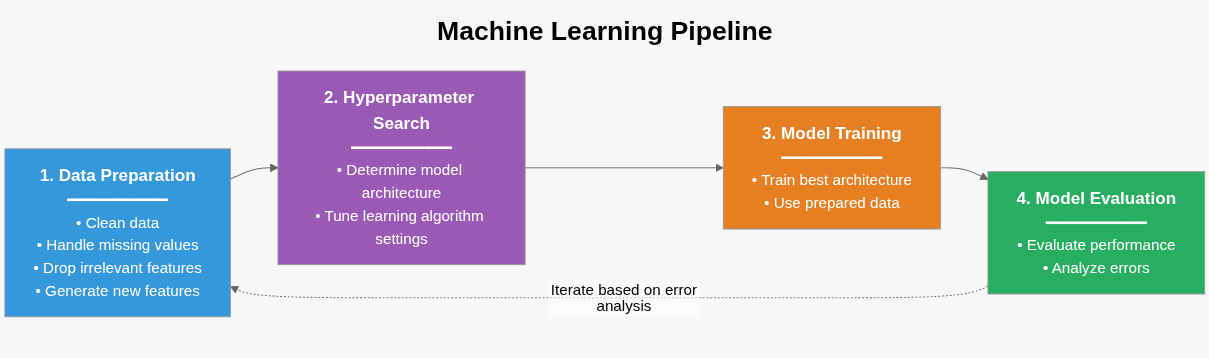
Learning Goals
- Create an incremental development plan for a machine learning project.
- Work on a self-directed project based on your plan.
- Set and meet incremental goals for a multi-week project.
- Understand and utilize the best practices for applying machine learning methods.
- Follow the CS research process to successfully draw conclusions about a real-world problem.
- Learn how to structure and write a scientific research paper in CS.
- Learn how to find and properly site scholarly sources for a bibliography.
- Learn how to use LaTeX to format a CS research paper.
Starting point code
Use git to clone your project repo from github.swarthmore.edu.
Your project repo contains the following files:
Makefile compiles the LaTeX files into pdfs
README.md where you will describe how to test your project code
project.bib where you will list the references for your paper
project.tex where you will write your initial draft and final paper
project_code.ipynb the notebook you should use to explore your dataset and implement your project
proposal.tex where you will write your project proposal
Due Dates and Deliverables
All deliverables are due by 11:59pm on the due date given.
- Nov. 18: Project proposal and dataset exploration
- Nov. 25: First draft of paper with introduction and references
- Dec. 11: Final version of paper
In your lab on Thursday, Dec. 3 or Friday Dec. 4, be prepared to demo your project code for your lab instructor.
Introduction
This project will allow you to spend several weeks exploring a machine
learning problem on a dataset of your choice. To find an appropriate
dataset, we suggest using
kaggle.com/datasets.
Kaggle hosts hundreds of thousands of datasets, so you should focus
your search. In the search bar, at the far right, you'll see the
option to select filters. We recommend filtering the dataset based on:
- File Types: CSV
- Usability Rating: 9.00 or higher
- Highly voted for: Learning
There are some data domains that you should avoid because they're
likely to be difficult to get satisfying results with. In general,
when humans are in competition with each other, the outcome of those
competitions tends to be difficult to predict. If you really want to
work on a topic like this, make sure you have a plan for how to have a
successful project even if prediction turns out to be impractical
(e.g. the learning algorithm produces very low performance
results). This can involve things like a focus on trying to draw
conclusions about the nature of the data (i.e. focus on what you *can*
discover that's interesting and worthwhile, rather than on the fact
that prediction is difficult).
Here are some examples of problem domains like this:
- Outcomes of sporting events (football/soccer, basketball, etc.)
- Outcomes of video games (e-sports, pokemon tournaments, etc.)
- Values of markets (stocks, indexes, GDP, etc.)
- Other domains in which humans are directly competing against other humans
As you consider various datasets, remember that all data must be converted into a numeric representation before applying logistic regression or neural network. For categorial data, you will likely want to use one-hot encodings.
Example Research Questions
Choose at least one of these questions to explore:
- Does feature selection help to improve performance?
- If your data has missing values, how do different strategies for handling them affect performance?
- Would using PCA or an auto encoder to do dimensionality reduction improve performance?
- Based on a hyperparameter search, what's the best performance we can get using an MLP classifier?
- How much better is an MLP classifier than a logistic regression model on this task?
- To what degree does your choice of performance measure (accuracy, precision, etc.) affect the hyperparameter search results? Are the results consistent across metrics?
Or come up with your own research question in consultation with the instructors.
Policy for AI use on the project
These policies are adapted from the AAAI conference policies:
- Prohibited Code and Text Generation: Content generated by an LLM is prohibited, unless the generated content is specifically part of the project's experimental analysis.
- Allowed Editing: You are permitted to use LLMs to edit or polish your paper.
- Full Author Responsibility: You are completely responsible for the entire content of your paper, including checking for plagiarism, accuracy and truthfulness of all text.
-
Acknowledge met of AI Use: You must disclose how AI was used in creating your project and paper. For example, see the acknowledgments section at the end of this web page.
Submitting
When you are finished, use git to add, commit, and push your work as usual.
Acknowledgments
The image at the top of this webpage was generated using Claude Fable 5.1. The prompt included the complete text for each box as well as the title.